Join the Yeast Vaccine Revolution
Genetically-modified yeast can turn a tube on your counter into a vaccine factory. No lab, no cold chain, no needles required.
How yeast vaccines work
Identify the antigen
Choose antigen gene(s) from the pathogen you want to protect against. Capsid/shell protein genes are prime candidates.
Insert plasmids
Clone those genes into plasmids alongside a custom, maltose-triggered promoter, then insert them into the yeast.
Culture the yeast
Grow the engineered yeast. At this stage the yeast is a vaccine factory, not a vaccine.
Switch on production
Maltose activates the promoter and the yeast fill with vaccine antigen (or display antigens on their surface).
Comsume it
Yeast survives stomach acid, then travels to M cells in the gut to trigger mucosal (and possibly systemic) antibody production.
Proven in animals
Across more than 20 published studies, oral yeast vaccines have raised both systemic (IgG) and mucosal (secretory IgA) antibody responses against viruses in mice, chickens, pigs, and fish. Yeast vaccines show great promise in protecting animal stocks from disease.
| Virus | Tested in | Yeast species | Format | Immune response | Study |
|---|---|---|---|---|---|
| SARS-CoV-2 | Mice | P. pastoris | killed · surface display | IgG2a · IgA · nAb | de Macêdo 2025 |
| SARS-CoV-2 | Mice | S. cerevisiae | live · surface display | IgG · IgA | Zhang 2022 |
| SARS-CoV-2 | Mice | S. cerevisiae | killed · surface display | IgG · IgA · IFN-γ · IL-4 | Gao 2021 |
| Influenza H7N9 | Mice | S. cerevisiae | killed · surface display | IgG · IFN-γ / IL-4 T cells | Lei 2020 |
| Dengue | Mice | S. cerevisiae | live · surface display | IgG · sIgA | Bal 2018a |
| Dengue | Mice | S. cerevisiae | live + killed · subunit | IgG · sIgA · lymphocytes | Bal 2018b |
| Enterovirus 71 | Mice | S. cerevisiae | live · surface display | IgG · IgM · IgA · TNF-α | Zhang 2016 |
| PRRSV | Mice | K. lactis | live · subunit | IgG · IgA · lymphocytes | Zhao 2014 |
| Fowl adenovirus | Chickens | S. cerevisiae | live · surface display | IgG · sIgA · IFN-α/β · CD8 | Cao 2022 |
| Influenza H5N1 | Chickens | S. cerevisiae | killed · surface display | IgG · IgA · IFN-γ · IL-4 | Lei 2021 |
| Infectious bursal disease | Chickens | P. pastoris | killed · subunit | IgM · IgY | Taghavian 2013 |
| African swine fever | Pigs | S. cerevisiae | live · surface display | IgG · IgA | Chen 2021 |
| Porcine epidemic diarrhea | Mice & piglets | P. pastoris | live · subunit | IgG · IgA | Wang 2016 |
| Porcine circovirus 2 | Pigs | S. cerevisiae | killed · surface display | IgG · IgA | Patterson 2015 |
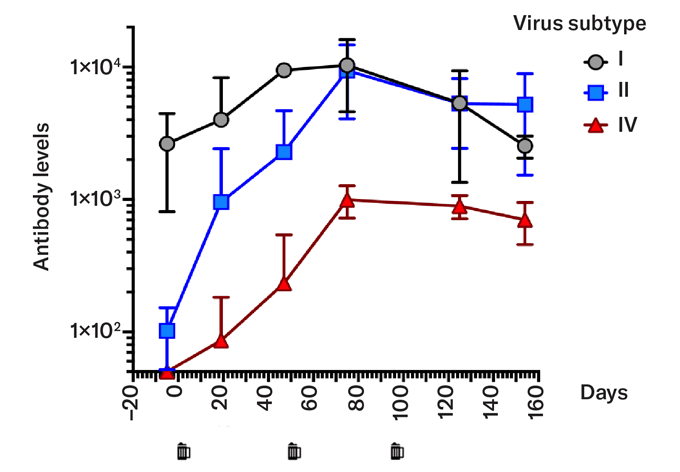
First Human Data
Benefits
Easy, cheap production
Oral or nasal delivery
Can be made shelf stable
No cold chain
Mucosal immunity
Generally Recognized As Safe
Read more
- "Vaccine Beer: A Personal Healthcare Report" — Christopher Buck and Andrew Buck
- "An Edible Polyomavirus Vaccine" — Buck et al.
- "Why yeast-based vaccines could be huge for biosecurity" — Dan Elton
- "Vac-Yeast Is a Food" — Chris Buck
Be part of the first human trials
Radvac is running a Phase I trial on the BK & JC Polyomavirus yeast vaccine developed in Chris Buck's lab at NIH. The trial will help prove out the technology and inform future development. Ebola, influenza, and COVID-19 are all candidates for future trials. Sign up to express interest in the Polyomavirus trial and be informed about future trials.